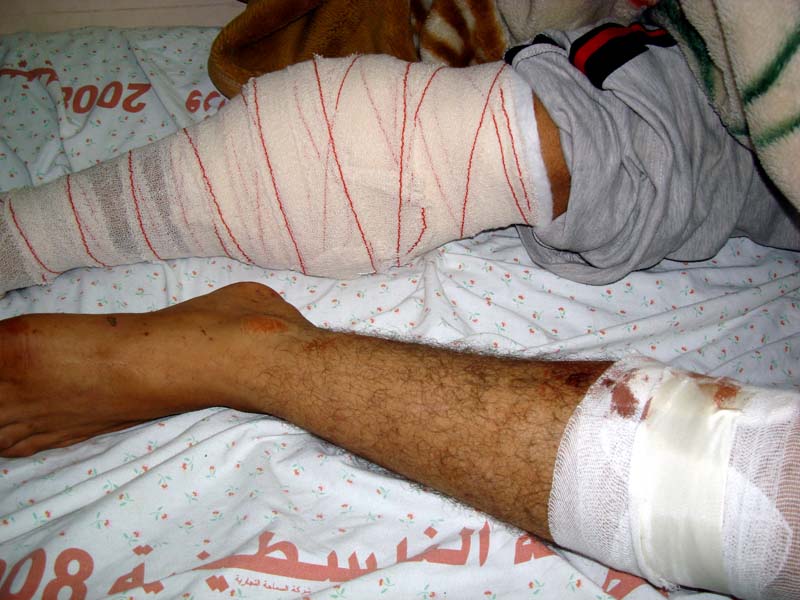
By Amira Hass
Haaretz
November 20, 2009
A friendly game between an Arab soccer team and a Palestinian team was supposed to inaugurate the new stadium being built in the eastern part of Al-Bireh, near Ramallah, at the end of the year. "Supposed to" because the Civil Administration, an arm of the Defense Ministry, has ordered that the work be halted and is threatening demolition.
FIFA, the international soccer federation, financed the stadium as part of a larger program to promote Palestinian soccer. The stadium covers 11 dunams (2.75 acres) and will hold 8,000 seats. An Israeli contractor, in partnership with a Dutch company and a Palestinian subcontractor, constructed the field.
In October 2008, when the field was ready, FIFA president Joseph Blatter and Palestinian Authority Prime Minister Salam Fayyad laid the cornerstone for the stadium. The governments of France and Germany are paying for the construction of stands. The outer wall, the lighting and the scoreboard are being financed by the Al-Bireh municipality, which owns the land and within whose jurisdiction the stadium is located.
In 1973, the municipality submitted for the approval of the IDF a detailed plan for the area where the stadium is now located. It received final approval from Israel's National Planning and Building Council and Supreme Planning Council in 1981. Nevertheless, on October 11 of this year, Israeli soldiers and representatives of the Civil Administration showed up at the site. They arrived via the neighboring Jewish settlement of Psagot, which overlooks Palestinian neighborhoods and was built on Al-Bireh land. They delivered a stop-work order from the administration to one of the workers (whose name was handwritten, in Hebrew, on it).
On November 1, the municipality received a "final" stop-work order - addressed anonymously to "the holder," from "the Supreme Planning Council's building inspection subcommittee," and issued by "Assaf."
The document claims that work on the stadium's stands is being carried out "without a license," and contains other standard admonitions: "You were given an opportunity to appear before the inspection subcommittee to state your case. The subcommittee has concluded that the aforementioned work was carried out without proper permission ... You are hereby obligated, in accordance with section .... of the 1966 City, Village and Buildings Planning Law, to cease activity upon and use of said land, and to raze the building ... and to restore the location to its previous state within 7 days ... If you do not act as required, all legal means will be taken against you, including demolition of the structure and any means required to restore the situation to its prior state, at your expense."
A German source has told Haaretz: "This could become a major diplomatic issue between Germany and Israel. Just imagine: A German-financed project being torn down. It would definitely be a political scandal."
Blots on the landscape
Why is the Civil Administration concerned with a soccer stadium located within Al-Bireh's municipal boundaries, which the IDF itself approved nearly 30 years ago?
It emerges that some of the land in question, which the municipality designated for a school and other public buildings in the early 1970s, had the misfortune to later be defined as being in Area C (see box). Amid the 11,000 dunams (2,750 acres) that fall within the city's bounds, there are several such Area C "blotches" - for the most part, in areas close to where the settlements of Psagot and Beit El, as well as IDF and Civil Administration bases, were built, on the lands of Al-Bireh and Ramallah. The headquarters of Jawal (the Palestinian cell-phone company) is located in Area C, as is the house of Dr. Samih Al-Abed, who heads the Palestinian team at the territory and border negotiation committee. Even part of the residence of PA President Mahmoud Abbas is in Area C.
The Al-Bireh municipality has not, however, received any maps from Israel demarcating the exact location of the parts of the town defined as Area C. Their location has been surmised, based on the tabu (Land Registry) documents submitted to the municipality, as per the 1995 Israeli-Palestinian interim agreement: The lots for which the Civil Administration did not submit documents to the city are understood to belong to Area C. But Area C is not a planning designation, per se.
"[It is] a political designation, which was supposed to be temporary - to last just 18 months," explained Al-Abed, an architect and city planner, and a former senior official in the Palestinian Planning Ministry.
"It is unjust, unreasonable and unfair to have to request and to wait for an Israeli license to build within the blotches of Area C that are within approved and recognized municipal areas," he said this week, pointing out that, "It is Al-Bireh that provides all services to the citizenry, including those bits of Area C that are in the municipal area: cleaning, garbage collection, maintenance, renovations, construction."
Musa Jwayyed, the Al-Bireh city engineer, says that over the years, various structures have been built in areas within the municipal borders that are apparently part of Area C, and that the city has also carried out the necessary infrastructure work in those areas, including preparation of a sewerage network, and the paving of roads and sidewalks - without requesting licenses from the Civil Administration.
Jwayyed: "Al-Bireh has another 18,000 dunams [4,500 acres] outside the municipal boundaries. Settlements sit on some of them, and the rest are private lands or our own land reserves. There I know I must have Israeli approval and coordination: such as for the renovation of the slaughterhouse, for reaching the municipal garbage-disposal site, for construction of a water-purification plant. But the stadium is located within the municipal boundaries that the IDF approved."
The question is: Why, all of a sudden, more than three years after construction of the entire project began and 10 months after construction of the stands started, has the Civil Administration decided to halt the work?
Ziv Nishri, the Israeli contractor who built the field, said in a telephone conversation: "The army knew about the project because it's impossible to do anything without the Civil Administration's approval. FIFA is the body dealing with the foreign minister. Without the umbrella of the Foreign Ministry, the army and the Civil Administration, nothing would be happening here."
When Nishri heard about the stop-work order this week, he was very surprised. "The plans for the stands are at least two years old. Even before we started on the project, I had the general plans for the stands, because we designed the field to fit them."
Officials at Al-Bireh city hall see a connection between the stop-work order, and the Palestinian refusal to return to the negotiating table as long as Israel does not freeze construction in the settlements, as well as the recent announcement by Prime Minister Fayyad of the planned consolidation of various Palestinian state institutions. The officials and local activists agree with Samih al-Abed when he says: "This is a typical kind of Israeli pressure, which means: 'Either you go back to negotiations or we'll punish you. We'll do whatever we can to upset your lives.'"
The coordinator of government activities in the territories responded to Haaretz: "Recently, there have been meetings and discussions between representatives of the Civil Administration and Palestinians at the very highest level, with the goal of resolving the issue of the construction of the Al-Bireh stadium. This has been in the wake of the official measures taken against the construction that was undertaken without the proper permits and in an illegal location. The Civil Administration is working with the civil-affairs ministry of the Palestinian Authority to prepare and submit an amendment to the existing zoning plan, and following that, the possibility of a permit, in principal, for the continuation of construction will be considered."
Source
November 21, 2009


Lost Livelihoods

By Eva Bartlett - November 21, 2009
East of Gaza city, on some of Gaza’s most fertile land, little to nothing is growing, and what had grown has been repeatedly mowed down over the years by Israeli military bulldozers and tanks.
I am re-visiting the region to record farmers’ words on a vital issue: water. Their wells and cisterns have also been bulldozed, pumps and motors destroyed. In some areas there is a complete lack of water; in another region east of Beit Hanoun there’s just one water source.
We see the remains of pumps, some destroyed in prior Israeli invasions, the majority destroyed (again) in the last Israeli attack, the winter massacre of Gaza.
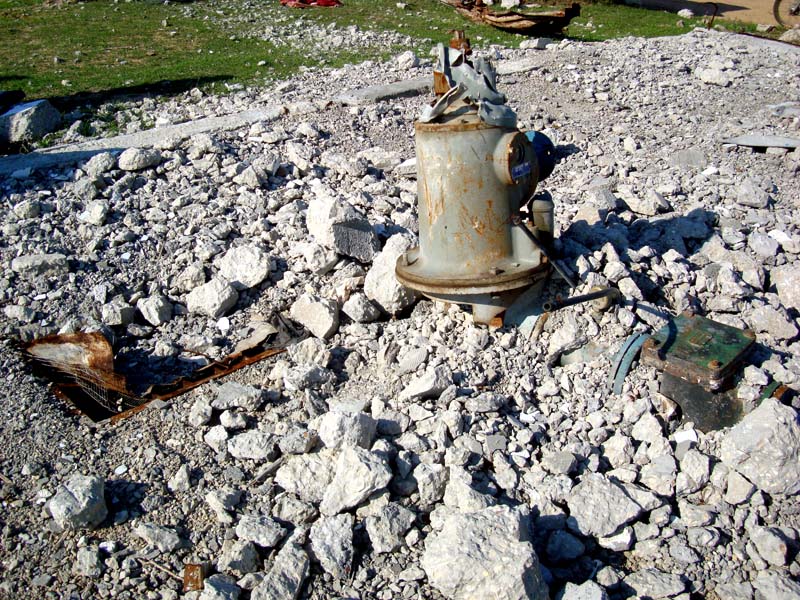
A cascade of house roofs and beams is nothing new, and taking the photo is more of habit than of awe.

Stopping for tea at one of the farmer’s houses, I expore what’s left of their farm livelihood. They are among the hundreds who have had their citrus, olive, and other fruit trees razed, their wells destroyed, their land polluted by chemical weapons.
I’m interested in bees, and want to know more about their small-scale honey production.
Turns out it used to be much larger: in 2004 they had 250 boxes of bees, each box containing up to 8 slots of bee hives (imagine a picture frame filled with honeycomb). These were destroyed when the Israeli bulldozers cut through their land.
Prior to the winter massacre, they had 80 boxes. But after the rockets and phosphorous, 15 boxes of bees perished. Along with the razed trees, bees and honey production in general got worse and worse, the bees no longer finding the flowers needed to sustain themselves.
The farm also lost 25 sheep during the massacre, I’m told.
Two handsome camels remain: a mother and her 8 month old son.

As we walk past more of the same: artfully destroyed homes, Mahdi, a Beit Hanoun resident, mentions that his family also kept bees. 500 boxes. All were lost in 2003 when the Israeli dozers came. His family has been raising bees for three decades, but with that invasion it came to an abrupt halt.
They did try again, he said. Two months ago they re-started their bee tending, but all the bees died, for want of flowers, trees, sustenance.
We won’t bother anymore, he told me. There are no trees in the area. Everything has been razed.
N. Ireland: Fermanagh skies being used to train Afghan war pilots
BY MICHAEL BRESLIN
November 18, 2009
AS Police try to establish reports of a downed plane in the Boho area on Thursday of last week, the British Army has denied that it was one of their drones.
However, an army spokesperson confirmed that the skies over north Fermanagh and west Tyrone are hosting 'rest of world' night time flight training for RAF and British Army Air Corps pilots.
A police spokesman referred enquiries about 'drones' in the sky at night to the British Army Press Office. He said that police were keen to speak to anyone who was flying in the Boho area on Thursday around the time of the 'loud bang' reports to contact them so they can be ruled out of their enquiries about a downed plane.
A British Army spokesman insisted that there was no training with unmanned drones: "Absolutely not. We don't train with drones. I don't know where they do most of their training, but I would suggest the Salisbury Plain.
Ironically, it was on Thursday night of last week that residents in an area embracing Enniskillen, Lisbellaw and Ballinamallard first heard the sound of an invisible aircraft. Then, on Friday and Saturday nights, residents in an area extending from Trillick through Irvinestown and across Lower Lough Erne were also treated to the same phenomenon. In all cases, witnesses described the sound as 'a continuous drone'.
The British Army spokesman told the 'Herald' that these were 'rest of world' operations by pilots of aircraft heading to war zones, including Afghanistan.
"As you know, with Northern Ireland being part of the UK, there is low level flying required to be done. A lot of that training, by the RAF and Army Air Corps, is done at night in order to replicate what they'll be doing overseas.
"You're talking about certain areas of, say, Afghanistan. You have desert and arid areas and, then you have areas which are lush and full of forests and green fields, so by flying around parts of Fermanagh and Tyrone you're making the exercise as relevant as possible."
The spokesman went on: "They can't do this during the day, but the guys have to get training. They can't do it in areas of light pollution and there's not much use doing it in built-up areas, such as towns and cities as this reduces the usefulness of flying by night.
"The pilots do try to change the areas they use for training so that nobody is getting grief. For instance, they use the Sperrins one week and the next week or the week after some other place. No, I don't know how long this will go on for."
Asked about one report that the training aircraft are equipped with heat-seeking equipment, the spokesman said this was 'unlikely'. "It's not something we talk about."
He was then asked to comment on one report that wind farms in the training areas are now fitted with beacons to avoid a collision.
"This would be a matter for the Civil Aviation Authority. It has got nothing to do with us. The CAA give directions for high structures and for emergency vehicles such as police, ambulance and fire tenders, or, say, the Harland and Wolff crane."
Ulster Unionist Councillor Alex Baird, who is a former civil representative with the Northern Ireland Office, said while he appreciates that the Ministry of Defence or the Royal Air Force are entitled to use the Fermanagh skies, he believes they should have been proactive in briefing public representatives about when this is going to happen.
Meanwhile, DUP Minister Arlene Foster explained: "Both Councillor Bert Johnston and myself received many calls over the weekend about the noise and length of time a night flying aircraft circled in parts of Fermanagh.
"I made contact with St Angelo Airport late on Sunday after residents in Lisbellaw expressed concern to me. The staff at St Angelo were very helpful and explained it was a military aircraft. This information was then shared around the community. I understand that many in the communities, both in Ballinamallard and Lisbellaw, were concerned at the length of time this aircraft was circling and of the noise generated from it," she continued.
"The NIO have explained there was a military training exercise in the area and that it is now finished. I was pleased both Bert and I were able to reassure the communities we represent, and my thanks go to the staff at St Angelo Airport for their assistance in getting the correct information via ourselves to the concerned residents who accepted the information we gave them."
Meanwhile, éirígí Fermanagh chairperson, Kevin Martin has expressed concern at the increasing level of British military activity in the county.
He commented: "In recent months, undercover British soldiers, who are most likely attached to the Special Reconnaissance Regiment, have also been active at PSNI checkpoints and in raids in the county.
"Yet again we are witnessing the consequence of Britain's continued involvement in Ireland. Despite the claims that the British army was going with the ending of Operation Banner in 2007, it is obvious that they are here to stay."
Mr Martin said that British military activity in Fermanagh, whether it be in training exercises or in operations against Irish citizens, was completely unacceptable: "éirígí will continue to actively oppose the British military presence in Fermanagh and across the Six Counties."
Source
November 18, 2009
AS Police try to establish reports of a downed plane in the Boho area on Thursday of last week, the British Army has denied that it was one of their drones.
However, an army spokesperson confirmed that the skies over north Fermanagh and west Tyrone are hosting 'rest of world' night time flight training for RAF and British Army Air Corps pilots.
A police spokesman referred enquiries about 'drones' in the sky at night to the British Army Press Office. He said that police were keen to speak to anyone who was flying in the Boho area on Thursday around the time of the 'loud bang' reports to contact them so they can be ruled out of their enquiries about a downed plane.
A British Army spokesman insisted that there was no training with unmanned drones: "Absolutely not. We don't train with drones. I don't know where they do most of their training, but I would suggest the Salisbury Plain.
Ironically, it was on Thursday night of last week that residents in an area embracing Enniskillen, Lisbellaw and Ballinamallard first heard the sound of an invisible aircraft. Then, on Friday and Saturday nights, residents in an area extending from Trillick through Irvinestown and across Lower Lough Erne were also treated to the same phenomenon. In all cases, witnesses described the sound as 'a continuous drone'.
The British Army spokesman told the 'Herald' that these were 'rest of world' operations by pilots of aircraft heading to war zones, including Afghanistan.
"As you know, with Northern Ireland being part of the UK, there is low level flying required to be done. A lot of that training, by the RAF and Army Air Corps, is done at night in order to replicate what they'll be doing overseas.
"You're talking about certain areas of, say, Afghanistan. You have desert and arid areas and, then you have areas which are lush and full of forests and green fields, so by flying around parts of Fermanagh and Tyrone you're making the exercise as relevant as possible."
The spokesman went on: "They can't do this during the day, but the guys have to get training. They can't do it in areas of light pollution and there's not much use doing it in built-up areas, such as towns and cities as this reduces the usefulness of flying by night.
"The pilots do try to change the areas they use for training so that nobody is getting grief. For instance, they use the Sperrins one week and the next week or the week after some other place. No, I don't know how long this will go on for."
Asked about one report that the training aircraft are equipped with heat-seeking equipment, the spokesman said this was 'unlikely'. "It's not something we talk about."
He was then asked to comment on one report that wind farms in the training areas are now fitted with beacons to avoid a collision.
"This would be a matter for the Civil Aviation Authority. It has got nothing to do with us. The CAA give directions for high structures and for emergency vehicles such as police, ambulance and fire tenders, or, say, the Harland and Wolff crane."
Ulster Unionist Councillor Alex Baird, who is a former civil representative with the Northern Ireland Office, said while he appreciates that the Ministry of Defence or the Royal Air Force are entitled to use the Fermanagh skies, he believes they should have been proactive in briefing public representatives about when this is going to happen.
Meanwhile, DUP Minister Arlene Foster explained: "Both Councillor Bert Johnston and myself received many calls over the weekend about the noise and length of time a night flying aircraft circled in parts of Fermanagh.
"I made contact with St Angelo Airport late on Sunday after residents in Lisbellaw expressed concern to me. The staff at St Angelo were very helpful and explained it was a military aircraft. This information was then shared around the community. I understand that many in the communities, both in Ballinamallard and Lisbellaw, were concerned at the length of time this aircraft was circling and of the noise generated from it," she continued.
"The NIO have explained there was a military training exercise in the area and that it is now finished. I was pleased both Bert and I were able to reassure the communities we represent, and my thanks go to the staff at St Angelo Airport for their assistance in getting the correct information via ourselves to the concerned residents who accepted the information we gave them."
Meanwhile, éirígí Fermanagh chairperson, Kevin Martin has expressed concern at the increasing level of British military activity in the county.
He commented: "In recent months, undercover British soldiers, who are most likely attached to the Special Reconnaissance Regiment, have also been active at PSNI checkpoints and in raids in the county.
"Yet again we are witnessing the consequence of Britain's continued involvement in Ireland. Despite the claims that the British army was going with the ending of Operation Banner in 2007, it is obvious that they are here to stay."
Mr Martin said that British military activity in Fermanagh, whether it be in training exercises or in operations against Irish citizens, was completely unacceptable: "éirígí will continue to actively oppose the British military presence in Fermanagh and across the Six Counties."
Source
IAEA Hopes to Rescue Third Party Enrichment Deal With Iran
Iran's 'Rejection' Apparently Greatly Exaggerated
by Jason Ditz, November 20, 2009
The persistent reports of Iran’s final rejection of the draft third party enrichment proposal has been greatly exaggerated, it would seem, and officials are scrambling to put forth a last ditch effort to rescue the proposal.
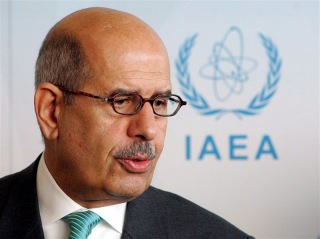
Mohamed ElBaradei
The P5+1 is reportedly expressing disappointment that Iran hasn’t approved the deal yet, and IAEA chief Mohamed ElBaradei expressed hope that Iran would take a “minimum risk” in the interests of peace and still approve the deal.
At the same time ElBaradei is urging Western officials to hold off on their oft-threatened sanctions against Iran, saying there was still time to rescue the deal.
The nuclear deal has been hugely controversial inside Iran, with many officials expressing doubts about France’s involvement in the third party enrichment process. Iran has sought to alter the deal to a direct exchange, which has met with Western opposition.
Afghan Nato raid ‘kills civilians’: video
by Al Jazeera
A joint Afghan-Nato raid has outraged Afghan villagers, who claim innocent civilians were killed.
The operation took place in the village of Haiderabad in Ghazni province early on Friday morning.
David Chater reports.
Israel arrests 5 top PA intelligence officers
Press TV - November 21, 2009 11:25:59 GMT
 |
Five senior Palestinian General Intelligence Service officers have been detained by Israeli forces near the West Bank village of Salfit in an overnight raid.
The detainees include Salfit region intelligence commander Mohammad Abdel Hamid.
The Israeli military has also demanded the Palestinians hand over an additional officer who was not apprehended.
A Palestinian security source said the Friday morning arrests were apparently made in the wake of an investigation being carried out by the General Intelligence Service against a man suspected of collaboration with Israel.
The PA assumes that the arrests are another attempt by Tel Aviv to dampen PA clout in light of the political row between Israel and the Palestinians.
The Palestinian Authority however said that they are in contact with Israel in a bid to secure the release of those arrested.
The Friday morning detentions are made at a critical juncture in relations between Israel and the Palestinian Authority. Acting PA Chief Mahmoud Abbas said Friday in an interview with the BBC Arabic service that there would be no peace talks with Israel as long as settlement construction continued. He also implied that his people might adopt a new type of struggle against the occupation.
"Those who have to resist are the people, and there are different types of resistance, like in Bilin and Naalin, where people are injured every day," he said.
November 20, 2009
Danish Public TV interviews Norman Finkelstein
English language starts at 45 seconds
Interview excerpt:
Norman Finkelstein: Hamas is not obliged under international law to accept the legitimacy of the state of Israel.
If you go back, for example, 1947 Gandhi said he’ll accept the reality of Pakistan, but he would never accept the legitimacy of the state of Pakistan.
Hamas is not expected to be held to a higher level of diplomacy than Gandhi.
Gandhi said: ‘Pakistan is a reality which I’m forced to accept, but I don’t accept it as legitimate.’ And that’s the same position of Hamas. They said we’ll solve the conflict on the June ‘67 border.
Adam Holm: This is what makes Jerusalem wary of Hamas because they keep saying how can we have a neighbor which doesn’t recognize our legitimacy.
Norman Finkelstein: But you see the problem is; listen to yourself,.. your own language..
You’re just spouting Israeli propaganda.
Why are you saying ‘Jerusalem’?
East Jerusalem is occupied Palestinian territory under international law, that was the ruling of the International Court of Justice since July 2004, and if you look at the Goldstone Report that just came out a month ago, they refer to East-Jerusalem as occupied Palestinian territory.
But now you’ve given over Jerusalem to the Israelis.
You’re just repeating Israeli propaganda; they have no title under international law to east Jerusalem.
Tip of the hat to Pulse Media
Gaza: Where is the buffer zone?
By Eva Bartlet - November 20, 2009
At 8:30 on November 15, a number of young men went as usual to the land near Gaza’s northern border with Israel, intending to catch birds. Amjad Hassanain, 27, was among the bird-catchers hunting near the border fence when Israeli soldiers began shooting.
The shots which missed the other bird-catchers hit Hassanain, grazing his shoulder.
Cameraman Abdul Rahman Hussain, filming in the vicinity, reports having seen the group of bird-catches head north.
“We were near the former Israeli settlement of Doghit,” said Hussain, referring to the area northwest of Beit Lahia in Gaza’s north.
“I had gone to the border area to photograph a young bird-catcher. We were about 400 m from the border fence, but when we heard the shooting, we moved back to around 1 km.”
According to Hussain, the other men had to carry the wounded Hassanain 1 km from the site of injury, then transferred him to a motorcycle and finally to a car.
“He was covered in blood, I couldn’t tell where he was hit,” said Hussain.
Hussain, there to document the work of bird-catchers, was surprised by the shooting.
“They always go there to catch birds. They put their nets close to the fence in order to catch as many as possible.” Like the bird-catchers, Hussain believed the Israeli soldiers along the border were familiar enough with the bird catching activity that they wouldn’t shoot.
Two hours later, Mahmoud Mohammed Shawish Zaneen and seven other farmers took a break from their work plowing land east of Beit Hanoun.
“We had three tractors with us. We’d been working since 8 am, planting wheat. At first we worked about 450 metres from the border fence, but later we were 700 metres away.”
The farmers had paused to drink tea when Israeli soldiers began shooting.
“The tractors were stopped and we were sitting on them. There were about seven Israeli soldiers, on foot. They shot the other tractors and then shot mine. They didn’t give us any warning, just started shooting.”
The bullet which pierced Zaneen’s left calf continued into his right calf.
Since the end of the Israeli massacre of Gaza last winter, at least nine Palestinians have been killed, and another more than thirty-four injured, by Israeli shooting and shelling in the border areas in Gaza’s north and east.
Ahmed Sourani, of the Palestinian Agricultural Relief Committee (PARC) has long been aware of the impact the Israeli-imposed “buffer zone”, a north-south width of 150 metres from the border fence at inception a decade ago. Currently, Israeli authorities warn that anyone within 300 metres of the border fence risks being shot.
Not only is the agricultural land within 300 metres of the border rendered off-limits, but also that of adjacent land, also subject to Israeli shooting.
Following the Israeli massacre of Gaza last winter, Sourani said that “PARC is fearful that the Israelis will extend that military zone to reach 2 km or more to the east and 3 km to the north, then turn it into a de facto situation.”
The impact on the agricultural industry of the Israeli-led siege on Gaza, the Israeli massacre of Gaza, and the imposition of the “buffer zone” has been profound:
International bodies cite 60,000-75,000 dunams [1 dunam is 1000 square metres] of farmland they say is now damaged or unusable.
World Food Programme (WFP) and the Food and Agricultural Organisation (FAO) said anywhere from 35 percent to 60 percent of the agriculture industry was destroyed by Israel’s attacks on Gaza.
Mahmoud Zaneen, still recovering from his injuries, says that his family of four has lost its only source of income.
“I usually work every day, if I can. I make 50 shekels per day.”
Until his legs recover, the family will be minus even that meagre salary. But Zaneen, despite his injuries, is determined to return to the fields.
“If there is work, I’ll go again.”
Rabbi's Followers 'Terror Cell in Parliament'
 Terrorists plan to commemorate Meir Kahane
Nazareth - November 20, 2009
A plan by right-wing legislators in Israel to commemorate the anniversary this month of the death of Meir Kahane, whose banned anti-Arab movement is classified as a terrorist organization, risks further damaging the prospects for talks between Israel and the Palestinians, US officials have warned.
A move to stage the commemoration in Israel’s parliament, the Knesset, is being led by Michael Ben-Ari, who was elected this year and is the first self-declared former member of Kahane’s party, Kach, to become a legislator since the movement was banned 15 years ago.
The US Embassy, in Tel Aviv, has sent a series of e-mails to Reuven Rivlin, the parliamentary speaker, asking that he intervene to block the event.
According to US officials, pressure is being exerted on behalf of George Mitchell, the US president Barack Obama’s envoy to the region, who is concerned that it will add to his troubles as Israeli and Palestinian leaders clash over a possible move by the Palestinians to issue a unilateral declaration of statehood.
Some Israeli legislators have warned that Mr Ben-Ari and his supporters are gaining a stronger foothold in parliament, in an indication of the country’s increasing lurch rightwards.
“Ben-Ari and the advisers he has brought with him are unabashed representatives for Kach and Kahane’s ideas,” said Ahmed Tibi, an Arab legislator and the deputy speaker. “What we have is in effect a terrorist cell in the parliament.”
Kahane, a US rabbi who emigrated to Israel in the early 1970s, advocated the expulsion of all Arabs from “Greater Israel”, an area that the far right believes encompasses not only Israel but also the occupied Palestinian territories of the West Bank and Gaza Strip, and parts of neighbouring Arab states.
Kahane was elected to parliament in 1984 but was barred from standing again four years later. He was assassinated by an Egyptian-American in New York in November 1990.
In 1994 Kach was declared a terrorist organization by Israel and the United States after Baruch Goldstein, a supporter, went on an armed rampage through the Ibrahimi mosque in the Palestinian city of Hebron, killing 29 worshippers and injuring 150.
Despite the ban, Kach is still active in many West Bank settlements, especially in and around Hebron, where shrines to Kahane and Goldstein regularly attract large numbers of devotees.
Mr Ben-Ari, one of four members of the National Union elected to the 120-seat parliament, has included as his parliamentary advisers two former Kach activists, Baruch Marzel and Itimar Ben Gvir, who are leaders of the far-right Jewish National Front. Mr Ben-Ari has never disavowed his support for Kahane, telling the Jerusalem Post newspaper this month that Kahane “dedicated his whole life to Israel … He was a great man and a great leader.”
This month Mr Ben-Ari was the voice on an advertisement on the Israeli radio station Reshet Bet to promote a public memorial service for Kahane held by his family. It was also reported that for the first time posters had been placed in many central areas of Jerusalem publicising the event and declaring “We all know now – Meir Kahane was right”.
The United States has expressed more concern, however, at a commemoration being planned in parliament.
Michael Perlstein, the second secretary at the US Embassy, is reported to have e-mailed Mr Rivlin several times, asking whether the commemoration was likely to be approved. According to e-mails leaked to the Israeli media, he added: “This is something Senator Mitchell and his team are following with some concern.”
An embassy spokesman reiterated those concerns last week: “To stir up controversy at the same time that we are trying to get people back to the [negotiating] table, is not productive of that effort. It is only natural that Senator Mitchell would be paying attention to that – and the US government as well.”
Mr Rivlin has reassured the United States that he has refused Mr Ben-Ari permission to stage a commemoration but has also admitted that it would be difficult for him to stop a “stunt” by Kahane supporters in the chamber.
“We are talking about a provocation,” Mr Rivlin told the Haaretz newspaper. “The man [Kahane] and his outlawed movement cannot be separated. This is an attempt to bring the Kach movement into the Knesset through the back door.”
Last week, Mr Ben-Ari appealed against the speaker’s decision to the House Committee, which rules on issues of parliamentary procedure. Mr Rivlin has said he will abide by the committee’s decision.
Its chairman, Yariv Levine of the ruling Likud Party, said he was not happy with Mr Rivlin’s refusal and is reported to be working with the speaker and Mr Ben-Ari to find a solution.
Mr Ben-Ari responded angrily to the US concern: “I was elected to the Knesset by citizens of the independent state of Israel. The flagrant involvement of Mitchell has crossed a red line and it testifies to the bowed head of the Knesset speaker that is turning the Knesset into a dish rag.”
Mr Ben-Ari is probably not the only former member of Kach in parliament. Avigdor Lieberman, the foreign minister and leader of the far-right Yisrael Beitenu party, the third largest in parliament, is believed to have joined Kach when he first arrived in Israel in the 1970s. His membership was revealed in February by Yossi Dayan, the movement’s former secretary general.
Last week Mr Ben-Ari had to cancel a trip to the United States, his first overseas visit, after he was refused a US visa. He had intended to speak to American Jewish groups to encourage emigration to Israel.
To date, the only authorized parliamentary commemorations are for Yitzhak Rabin, the prime minister assassinated by a right-wing Jew in 1995, and for Rehavam Zeevi, a former general and leader of a far-right anti-Arab party, who was assassinated by Palestinian gunmen in 2001.
Jonathan Cook is a writer and journalist based in Nazareth, Israel. His latest books are “Israel and the Clash of Civilisations: Iraq, Iran and the Plan to Remake the Middle East” (Pluto Press) and “Disappearing Palestine: Israel's Experiments in Human Despair” (Zed Books). His website is www.jkcook.net.
A version of this article originally appeared in The National (www.thenational.ae)
The New York Mets and the business of terrorism
Aaron Levitt, The Electronic Intifada, 20 November 2009
When I first learned that the New York Mets were hosting a fundraiser for the nonprofit Hebron Fund at Citi Field in support of the Israeli settlers in the occupied West Bank city of Hebron, I honestly assumed it was a joke, albeit a poor one. When I realized this was an actual, planned event, I still found it almost impossible to believe. This is because, even aside from the devastating impact of settlement expansion on the prospects for peace in the region, I have had the misfortune to see, repeatedly and at first hand, the fruits of the Hebron Fund's labors.
During the summers of 2005 and 2006, and very briefly in 2008, I spent several weeks working as a human rights observer in the Tel Rumeida section of Hebron, home of the Beit Hadassah and Tel Rumeida settlements that are supported by The Hebron Fund. During that time, I encountered racist graffiti with such statements as "Gas the Arabs" and "Fatimah, we will rape all Arab women." I repeatedly observed settlers throwing stones and clods of earth at young Palestinian girls on their way to elementary school; yelling racial epithets at Palestinians walking in the streets; pushing, kicking, and spitting on Palestinian children and (occasionally) adults who were quietly minding their own business; and hurling large stones down on Palestinian homes and residents from settlement balconies.
I have witnessed this behavior by men and women, boys and girls, from pre-school-aged children to middle-aged adults. I was myself assaulted, on Shabbat, by a group of six teenage settlers, when I came between them and their intended victim, an elderly Palestinian woman who also happened to be the proud mother of a US Navy fighter pilot (the picture of her son standing by his plane was prominently displayed on her living room wall). The settler youths then turned to attack my companion, a young Scandinavian woman who was videotaping the original assault. I have heard and read numerous, credible reports of far worse violence than I personally experienced from other human rights observers, who were in the area for different and/or longer periods.
The Hebron settlers engage in this violence for the express purpose of driving out Palestinian families from Tel Rumeida, site of the Cave of Machpelah, or Cave of the Patriarchs, which is holy to both Jews and Muslims. Settler leaders have said as much in at least one published interview, and a young man from the Beit Hadassah settlement confirmed it to my face in September 2006. The settlers' efforts have been remarkably successful: of more than 600 Palestinian families originally living in the neighborhood, probably less than 100 remained when I was last there in 2008. If the settlers continue to receive free reign, and full funding, we may soon add a new chapter of completed ethnic cleansing to the troubled history of this ancient city.
According to the US Code, Title 22, Chapter 38, S 2656f, our country defines terrorism as "premeditated, politically motivated violence perpetrated against noncombatant targets by subnational groups or clandestine agents." The Hebron settlers' violence is certainly premeditated. It is, by their own admission, politically motivated. It is perpetrated solely against noncombatant targets (overwhelmingly children), and it is obviously the work of a subnational group -- the settlers themselves.
The business of the Hebron settlers is terrorism, pure and simple; not quasi-terrorism, crypto-terrorism, neo-terrorism, potential terrorism, or something akin to terrorism, but the very thing itself. And the business of the Hebron Fund is funding terrorism. This does not mean that all, or even most, donors knowingly support these actions; many may be innocent victims misled by the fund's innocuous marketing materials. Although the fund's staff and Board member attempt to maintain a cloak of respectability, they are another matter entirely.
This year's Hebron Fund dinner will "honor" Hebron settler and spokesman Noam Arnon (whose picture is featured with other "Hebron Fund and Hebron Community Leaders" on the Hebron Fund website). In 1990, Arnon told Israel Radio that three Jewish militants, convicted of car-bombings that killed three Palestinians and maimed two Palestinian mayors, were "heroes" who sacrificed themselves "for the security of Jews." In 1995, Arnon was further quoted by the Associated Press when he called Baruch Goldstein, another settler who slaughtered 29 Palestinians at prayer in Hebron and injured more than 100 others, an "extraordinary person" denied "historical justice."
The 2008 Hebron Fund dinner honored Board member Myrna Zisman, who accepted her award on behalf of Yifat Alkoby, an "extraordinary woman" who received international attention in 2006 when she was videotaped repeatedly calling a Palestinian woman and her daughters whores and telling them to stay in their "cage," as the family sought refuge in their own home, with bars on the windows to protect them from recurring settler attacks.
I could say something about how the Mets, as a treasured New York City institution, shouldn't be lending their facilities, or their name, to such practices, and that would certainly be true. I could say something about the extraordinary irony of such an event being held on top of the Jackie Robinson Rotunda, and that would be true as well. Yet the larger truth is that no American team, no American business, and no American individual should be providing material support for terrorism, or assisting those who provide such support. Unless and until the Mets reverse their terribly ill-considered decision to host this event, that is precisely what they have chosen to do.
Aaron Levitt is a member and past board member of West End Synagogue in Manhattan, a member of Jews Against the Occupation (JATO), and is presently Director of Research at a large New York City social services agency. Levitt has been working in support of a just peace in Israel/Palestine for the past seven years. He can be contacted at aaronjlevitt A T gmail D O T com.
 |
By hosting an event in support of Hebron settlers at Citi Field, the New York Mets are supporting terrorism. (Mamoun Wazwaz/MaanImages) |
When I first learned that the New York Mets were hosting a fundraiser for the nonprofit Hebron Fund at Citi Field in support of the Israeli settlers in the occupied West Bank city of Hebron, I honestly assumed it was a joke, albeit a poor one. When I realized this was an actual, planned event, I still found it almost impossible to believe. This is because, even aside from the devastating impact of settlement expansion on the prospects for peace in the region, I have had the misfortune to see, repeatedly and at first hand, the fruits of the Hebron Fund's labors.
During the summers of 2005 and 2006, and very briefly in 2008, I spent several weeks working as a human rights observer in the Tel Rumeida section of Hebron, home of the Beit Hadassah and Tel Rumeida settlements that are supported by The Hebron Fund. During that time, I encountered racist graffiti with such statements as "Gas the Arabs" and "Fatimah, we will rape all Arab women." I repeatedly observed settlers throwing stones and clods of earth at young Palestinian girls on their way to elementary school; yelling racial epithets at Palestinians walking in the streets; pushing, kicking, and spitting on Palestinian children and (occasionally) adults who were quietly minding their own business; and hurling large stones down on Palestinian homes and residents from settlement balconies.
I have witnessed this behavior by men and women, boys and girls, from pre-school-aged children to middle-aged adults. I was myself assaulted, on Shabbat, by a group of six teenage settlers, when I came between them and their intended victim, an elderly Palestinian woman who also happened to be the proud mother of a US Navy fighter pilot (the picture of her son standing by his plane was prominently displayed on her living room wall). The settler youths then turned to attack my companion, a young Scandinavian woman who was videotaping the original assault. I have heard and read numerous, credible reports of far worse violence than I personally experienced from other human rights observers, who were in the area for different and/or longer periods.
The Hebron settlers engage in this violence for the express purpose of driving out Palestinian families from Tel Rumeida, site of the Cave of Machpelah, or Cave of the Patriarchs, which is holy to both Jews and Muslims. Settler leaders have said as much in at least one published interview, and a young man from the Beit Hadassah settlement confirmed it to my face in September 2006. The settlers' efforts have been remarkably successful: of more than 600 Palestinian families originally living in the neighborhood, probably less than 100 remained when I was last there in 2008. If the settlers continue to receive free reign, and full funding, we may soon add a new chapter of completed ethnic cleansing to the troubled history of this ancient city.
According to the US Code, Title 22, Chapter 38, S 2656f, our country defines terrorism as "premeditated, politically motivated violence perpetrated against noncombatant targets by subnational groups or clandestine agents." The Hebron settlers' violence is certainly premeditated. It is, by their own admission, politically motivated. It is perpetrated solely against noncombatant targets (overwhelmingly children), and it is obviously the work of a subnational group -- the settlers themselves.
The business of the Hebron settlers is terrorism, pure and simple; not quasi-terrorism, crypto-terrorism, neo-terrorism, potential terrorism, or something akin to terrorism, but the very thing itself. And the business of the Hebron Fund is funding terrorism. This does not mean that all, or even most, donors knowingly support these actions; many may be innocent victims misled by the fund's innocuous marketing materials. Although the fund's staff and Board member attempt to maintain a cloak of respectability, they are another matter entirely.
This year's Hebron Fund dinner will "honor" Hebron settler and spokesman Noam Arnon (whose picture is featured with other "Hebron Fund and Hebron Community Leaders" on the Hebron Fund website). In 1990, Arnon told Israel Radio that three Jewish militants, convicted of car-bombings that killed three Palestinians and maimed two Palestinian mayors, were "heroes" who sacrificed themselves "for the security of Jews." In 1995, Arnon was further quoted by the Associated Press when he called Baruch Goldstein, another settler who slaughtered 29 Palestinians at prayer in Hebron and injured more than 100 others, an "extraordinary person" denied "historical justice."
The 2008 Hebron Fund dinner honored Board member Myrna Zisman, who accepted her award on behalf of Yifat Alkoby, an "extraordinary woman" who received international attention in 2006 when she was videotaped repeatedly calling a Palestinian woman and her daughters whores and telling them to stay in their "cage," as the family sought refuge in their own home, with bars on the windows to protect them from recurring settler attacks.
I could say something about how the Mets, as a treasured New York City institution, shouldn't be lending their facilities, or their name, to such practices, and that would certainly be true. I could say something about the extraordinary irony of such an event being held on top of the Jackie Robinson Rotunda, and that would be true as well. Yet the larger truth is that no American team, no American business, and no American individual should be providing material support for terrorism, or assisting those who provide such support. Unless and until the Mets reverse their terribly ill-considered decision to host this event, that is precisely what they have chosen to do.
Aaron Levitt is a member and past board member of West End Synagogue in Manhattan, a member of Jews Against the Occupation (JATO), and is presently Director of Research at a large New York City social services agency. Levitt has been working in support of a just peace in Israel/Palestine for the past seven years. He can be contacted at aaronjlevitt A T gmail D O T com.
Subscribe to:
Posts (Atom)

 Posts
Posts